Thursday, 3 September 2015

Perspective

As I prepare for my final festival I reflect on the news. The refugee crisis (misnamed 'migrant crisis' by BBC and others) is escalating. The bodies of dead Syrian children are washed up on European beaches, hundreds sleep on a station platform, unable to use their tickets for freedom, bodies are discovered in sealed trucks, traffickers pocket huge profits from human suffering, politicians equivocate, as they do.

The worst humanitarian crisis since the second world war is unfolding on our screens, before our eyes; people of faith and good will do what they can with collections of money and essentials. Leaders argue over what can be done, claiming to act with public opinion, overlooking the clamour for compassionate action, overlooking what must be done, overlooking action against root causes in favour of short term populist expediency.

Today my Sabbatical topic seems a bit shallow: the thousands fleeing persecution, risking everything know little of popular culture yet they hold onto a deep spirituality.

Lord. may I never loose sight of the bigger picture of what is happening in your world, of our interconnectedness to all people, to all creation.

Thanks to Ruth Gee for this prayer that was posted by a friend on Facebook:

So small, so still
So beautiful in life
So unbearable in death
Carried by the sea
Carried by our tears
Carried gently in strong arms.
O God
Open the eyes of those with power
To see your children in their desperate need;
Open the arms of those in government
To welcome those who come to our shores;
Open the hearts of each one of us -
Move us to sorrow, anger and action
That the salt sea of sorrow
May be turned to soothing waters
And that tears of desperation
May become tears of joy.
O God help your people.

Wednesday, 2 September 2015

Festival Reflections 3 – Greenbelt


 ABOUT GREENBELT
The Twitter intro says it all: ‘Engaged with culture, inspired by the arts, sustained by faith, we aspire to be an open, generous community’

Established for over 40 years Greenbelt has a real sense of community – people meet up at the festival and maintain contact all year round. I went  alone but wasn’t on my own; I met up with friends from Sheffield and beyond and shared experiences along the way. Everywhere you went there were people willing to engage in conversation and freindly greetings.

Like Latitude, it is much more than a music festival with poetry, performing arts, discussion and debate on offer across the various site venues. Unlike Latitude, it is propelled by recognition of ‘the other’ with a strong emphasis on Christianity but representatives of other faiths and belief systems alongside. (It was actually more ‘Christian’ than I had expected)

Greenbelt moved to its present home, Boughton House Kettering two years ago and this was clearly a wrench for some. The general view I heard was that this had been a good move as the picturesque grounds add something to the sense of awe that pervades the festival in sunshine and rain (we had both)
 
MY GREENBELT
I knew from others (and experience of other events) that you must beware festival fatigue. I therefore took a conscious decision to focus on events that resonated with my theme of spirituality in popular culture. It’s only when I returned home that I had a sense of all that I had missed in the other parts of the festival but there just isn’t enough time to do everything! And having decided to merge with a trip to Fusion (see earlier blog) I had to keep focussed. So perhaps I’ll go again in the future maybe even for a day to catch some other strands of the numerous experiences on offer.

So I saw Madeline Bunting on Mindfulness (see earlier), Dave Andrews on the Jihad of Jesus (how Christians and Muslims can share their understanding of who Jesus is), Making Faces theatre group on 11 things to do before I die, Joanna Jepson (Chaplain to fashion industry) on that industry’s power, Paula Gooder on Seeing God in the Everyday, Kate Bottley – Gogglebox Vicar on media, Steve Chalke on Being human. Other snippets throughout the weekend such as a debate on Christians in politics, fire show, the right to offend and much more besides.

Music acts included Josephine, Duke Special, Speak Brother, Worry Dolls, Martyn Joseph, Iain Archer, Danni Nicholls, Sam Brooks and the Unthanks. There was a folk/country theme in many acts with soul, indie and pop as well. Not all songs were faith based by any means but there were positive words about  love and hope to be found as well as strong messages about social justice and equality.

Sunday morning was communion celebrated by two women Bishops (including +Libby) and led by members of two rural religious communities. The theme was about relationships between humans and all creation and the importance of seeing the created order as part of God’s purposes and not a commodity to be used by humankind. Good spirit present but a shame that there wasn’t much contemporary music (and in some cases language)

GREENBELT WORLDVIEW
Arts, faith, culture as it says. There was a strong leaning towards social justice with talks about migrant/refugee issues, ISIS, austerity, poverty, politics. Also a very present green thread in the ethical outlets, presentations and the presence of forest church. I had a brief chat with someone about this movement but unfortunately didn’t have much time to explore. My conversation picked up a fascinating Gaia/ Pagan/Christian connection.

Christian Aid. Embrace, Liveability and many other relief, support and educational charities were present in the well-resourced exhibition centre ‘G-Source’ and this was matched by a comprehensively stocked bookshop. (I resisted!)  

The communion service summed up the worldview very well by focussing on the fact that we are all connected as humans, as people of faith and as the created.


GOD AT GREENBELT
Yes of course!

From the sessions I attended and casual conversations, my sense is that those at Greenbelt were very much alive to the reality of God existing outside the church! I have commented on Madeline Bunting’s dissatisfaction with organised religion and her incredulity that compassion can be found within Christianity. But this was a theme I encountered elsewhere. Dave Andrews suggested that Christianity had got in the way of people finding Jesus (he never wanted to found a religion), Steve Chalke contrasted the fruits of spirit with the dominant Greek world view which was more about power than love – yet that is often where the church is today. Paula Gooder challenged her audience to recognise God at work wherever God’s characteristics are seen at work (in love, bringing new life, hope etc.) Finding God in the unexpected (where have I seen that before?)

 
Setting this alongside some of my reading and other festival reflections, it affirms for me the importance of church connecting with culture and offering an alternative to the negative narrative of judgementalism, bigotry, homophobia, misogyny and abuse that often populates the media and seeps into current thinking. Greenbelt and so many other places of living faith demonstrate that this is just not the universal case!


I am sure that many Greenbelters are regular church member (I certainly bumped into a number) but from brief chats around the site, my sense is that others are more on the fringes, maybe those dissatisfied with traditional church who are part of other Jesus/God centred movements or even those who rely on this annual event for their primary spiritual input. Greenbelt certainly strives (and succeeds) to equip people of faith in their daily lives but I guess it doesn’t set out to be a para church!


FINALLY

I feel that that I shall continue to draw on the resources of Greenbelt for some time in a way that perhaps I am not doing for the other festivals.  

I realise that when I read back much of what I have written (and even more of what’s in my mind) it comes out a being very negative about the Church. Yet this beautiful creation is the Bride of Christ. Greenbelt is the church! New shoots of Christian community are the church! I have a role (roles) in the church! We need to break out of institutionalised thinking!

A Fusion of ideas


A weekend of contrasts! Not just in the weather – gloriously warm and sunny on Saturday, dull, wet and cool Sunday and Monday – but in the events I attended. The decision to juxtapose Greenbelt and Fusion seemed like a good idea at the time and I would probably have enjoyed both even more if I had attended them both all the time – however I think I got a lot out of the two events and reflecting on what each said to the other. So here I’ll share my thoughts on the fusion of ideas that emerged as I moved from Greenbelt (Kettering) to Fusion (Birmingham).


Main arena at Greenbelt with Boughton Houise lake in foreground
I shall go onto a bit more detail about Greenbelt elsewhere but just to say that it is a festival of ideas, arts and music where faith and justice meet. I arrived on Friday afternoon, settled in, found my way round and went to various events. Saturday dawned fair and I listened to a talk by Madeline Bunting before heading off to the sunny Cofton Park to spend the day with maybe 10,000 people (many families and young people as well as a few old dudes) listening to 9 pop acts – indie, hip-hop and house included. The big draw for me was Clean Bandit (my favourite techno-house classical fusion band, as mentioned weeks ago!!) but I was also impressed by Labyrinth, Sigma, Ella Henderson and Rudimental to name but a few.

Back to Greenbelt. Madeline Bunting (Writer, Social Activist and Guardian Journalist) was speaking about ‘mindfulness’ – a new trend that is making big inroads into the workplace and life generally. The basic idea is that we should discipline ourselves to spend at least 10 minutes a day centring down, focussing on our breathing, and avoiding distraction. The mindfulness movement has some scientific backing and has demonstrated that the techniques can relieve stress and tension and improve wellbeing. It’s being seen as a significant way to reduce the reliance on prescription anti-depressants. A key element is being aware of the inner narrative which is so often judgemental (about self and others) and interrupting the flow of these thoughts so as to focus on positive thoughts (I simplify of course!).

It is becoming popular because it has no creed, dogma, institution or priests (although scientists behind it are looking for some codification and recognition). It is wholly experiential – not reliant on outward practices and it is seen as a practical response to the exhaustion of our 24/7 culture.

Madeline herself has now left the Catholic Church in which she was brought up and favours a Buddhist way of life. Questioners at her session compared mindfulness with Christian (e.g. Ignation) contemplation and she noted that in this tradition there was more reliance on the use of words (not wholly true?). What saddened and surprised me most was her response to a point made about Jesus who said ‘blessed are the meek’ and himself practiced spiritual discipline. Madeline who had clearly been scarred by religious experienced commented (I paraphrase) ‘If you have managed to find the hidden thread of compassion in Christianity – good luck to you’

Here we see yet another example of contemporary people turning away from Christianity (or perhaps more accurately the Church) because they do not associate it with love, compassion, wellbeing or a meaningful response to the problems of contemporary life. (I could further critique this by commenting that Madeline’s notion of mindfulness is firmly rooted in western society – what would it have to say to those refugees immersed in a 24/7 struggle for survival?)

So with these thoughts ringing in my ears and the words from ‘The Shaping of Things to come’ also swirling round I approached Cofton Park. In their book, Frost and Hirsch several times consider how the church relates to people outside. Using the example of bikers gathering on a Sunday, they suggest that few bikers would probably come to a special biker-friendly service at the local church, but more would be influenced by Christians who joined their bikers group. The same can be said for many other ‘tribes’ not least pop fans (see the segway there?)

So Fusion, like the many other festivals happening over Bank Holiday weekend attracted huge numbers of people who enjoyed the music and atmosphere. Someone I bumped into at Greenbelt commented how much they enjoyed festival because for one weekend a year they could be someone else, they could be anonymous. The same can be said for Fusion and the festivals I’m sure.

Once again I was struck at how well the crowds knew the words of the songs.  I’ve been listening to ‘New Eyes’ by Clean Bandit for months but can still only manage to mumble a few  choruses. The fans knew all the words to all their songs as well as many of the other acts. How do they do it? I can only imagine it’s because they take the songs with them on various devices wherever they go, and through numerous repetitions they sink in. Just like the Psalms, Wesley Hymns Taize and Latin chants; we’ve surely lost something of that in the modern (Western) church haven’t we! Perhaps because we only ‘do’ church on a Sunday, unlike the music fans who are constantly plugged in to their music or indeed my dear Mother in Law who would sing Wesley hymns when dong the housework!

Reflecting on Madeline Bunting’s talk and the upsurge in interest in Mindfulness I was struck how many lyrics were about people seeking their identity, recovering from abuse, standing up for themselves, seeking and finding and loosing love. Once again there were numerous spiritual themes and even references to Biblical narratives in many of those lyrics that I could make out:

I keep going to the river to pray
'Cause I need something that can wash out the pain
And at most I'm sleeping all these demons away
But your ghost, the ghost of you
It keeps me awake
(Ella Henderson: Ghost 2015)

And when we started out
Out in those I Love You days
The days that seemed so bright
You brightened up inside
The side of you I loved
The love we had you crucified
(Ella Henderson: Pieces 2015)


One performer introduced her song by saying it was for anyone who had been treated badly by another person and asked for a show of hands of those in the audience who had the same experience. Over half of the young hands I could see in front of me shot up in the air.  Surely these people need mindfulness. Surely they need to know love, hope and forgiveness. Surely they need the gospel! But will they go to their local church to find it or do we need to release Christian pop fans to get alongside them??

Here’s just one example of lyrics that have deep meaning:

Even when you let me down
I forgive you in the end
What goes round comes back around
So I'll wait for you till then
If that's not enough, oh, no, no
Tell me what would be enough, be enough, be enough, be enough

And what is love
If you're still searching for something?
And what is love
If it's building up to nothing?
We'll never see how far we've come
But we keep looking at the sun
So what is love
If we're still searching for something?

Get higher, higher, higher
We keep looking up
Higher, higher, higher
But we're still not high enough
Higher, higher, higher
We keep looking up
Higher, higher, higher
But we're still not high enough

(Sigma ft Labyrinth 2015)

And as well as the lyrics there was the sense of closeness, community and togetherness. When ‘Shine like a diamond’ was sung the crowd made diamonds with their fingers and held them up high. As Clean Bandit sung ‘extraordinary’ every hand in the arena went up as if the crowd was joining in the search for something special, something beyond the ordinary, maybe beyond the daily lives that would summons them back to normality in two days’ time?

Something extraordinary
Something real
To fill my days and nights with something
That I can feel (I can feel)

(Extraordinary Clean Bandit 2014) 


Wednesday, 26 August 2015

Another urban walk

Revelation 22:1-2 NIV
Then the angel showed me the river of the water of life, as clear as crystal, flowing from the throne of God and of the Lamb [2] down the middle of the great street of the city. On each side of the river stood the tree of life, bearing twelve crops of fruit, yielding its fruit every month. And the leaves of the tree are for the healing of the nations.

Today I followed the Sheaf River walk and part of Sheffield Round walk via Ecclesall woods to Whirlow. This was the first time I'd stuck to the actual route which zig zags either side of the Sheaf. Beginning at Granville Square the route follows the river through polluted, graffiti covered urban cityscape , past retail and commercial premises to the more orderd suburban Millhouses Park. 

Yet the same water flows throughout, just as the river of God and the Church of Christ flow throughout history and every aspect  of creation bringing life. 

Again I was struck by the unexpected. I probably drive the roads either side of the Sheaf most days however today I saw sights that were new to me including a crown of thorns in Heeley People's Park,  Two challenging skeletons adjacent to Virgin Gym and a hidden pool in Ecclesall woods. See pictures below.  I was also surprised to see a reminder of God the Father only to discover that the Father's heart is nothing more, or less than a kitchen showroom! 

I've also started reading 'The shaping of things to come' by Michael Frost and Alan Hirsch. The writers challenge the church to leave behind the Christemdom model and return to the vision of the early church. Chiming directly with my theme they ask:'what has God called us to be and do in our current cultural contect'Spot on! 

They predict that the days of the static,  rooted  institutionalised church are numbered.  People are searching for something that is relational. They call for us to become transformative subversive  missionary  innovative and imaginative. Much to ponder on in the days ahead as I continue my encounter with spirituality in popular culture and start to reflect on how this sabbatical experience will speak to my discipleship  ministry and Superintendency. 


Monday, 24 August 2015

On the importance of listening....

Personal Jesus: How pop music shapes our souls (Clive Marsh and Vaughan S. Roberts: Baker Academic 2012)

When I read books by Ted Turneau and Steve Turner I was enlightened and encouraged that writers and thinkers shared my belief that pop culture (music in particular) was something worth engaging in from a Christ centred perspective. I was however a little uneasy that these writers were looking at ways of using such culture to underpin Biblical themes rather than enabling Christians to approach culture from where it is, and to see how God is at work within culture.

Marsh and Roberts have addressed these concerns in their excellent (and much more academic) book. I’m not going to try to critique this but will draw out some of the thoughts I felt most valuable. These start with a quote which I think meets the concerns addressed above:

‘..listening must be intense and genuine; it must take account of what performers and listeners want to say and do, and not just what we happen to (want to) hear’ (129)

And again: ‘Those who lead worship or preach may use or refer to music that they know or assume their congregations are listening to. But too often sermons […] often deal only with lyrics, lyrics that are conducive to what the preacher wants to say anyway’ (184)

Much of their writing focusses on listening which of itself is seen as a spiritual practice and after Markham, introduce the reader to the notion of ‘overhearing’ (which reminded me of John Stott’s ‘double listening’ to the world and God) ‘Overhearing is being open, simply to what is there.  Our discipline of listening means that we listen to music by people of many faiths and none, sometimes by people indifferent or hostile to faith. But nevertheless music is there, shaping the world of Western citizens, people of faith and no faith, and filling the awareness and echoing spaces of shopping malls across the Western world’ (128)

There is an enormous amount of great value in the book to anyone who is trying to delve into popular culture. I’ll just summarise one section that I found particularly helpful (p 146ff)

In this section the writers bring together their own thoughts and map them alongside the contributions of others to produce ‘Dominant Themes from the Use of Popular Music; A working Summary’

TRANSCENDENCE
Revelation – a gift from outside the present experience, a loss of control, a sense of ‘otherness’ ‘to speak of an experience of transcendence as revelatory, then, can legitimately be interpreted as an experience of God (a divine/deity reality), in whatever form ‘God’ is understood.’ (147)

A doctrine of God – insofar as transcendence encourages a reflection upon life. This encompasses a challenge about the place of ‘God’ within a reflective approach to living.

Christology – To be taken out of ourselves require us to be aware of our bodies (You can’t have an out of body experience without first recognising that you have a body!) The incarnation of Christ and Paul’s emphasis on the body illustrate God’s concern for the body. (I recall the impact of being among so many bodies at festivals).

Spirit - relates to soul, inner life, dynamism, creativity. Being human is not reduced to the material only; Western world is more comfortable with spiritual than religious language but we must not lose sight of the Christian perspective that Spirituality exists within the body.
Salvation – In the sense that music can lead to liberation and a sense of well-being

Eschatology – Any claim for transcendence includes within it an implied understanding of existence which will be reflected on how one views the ‘last things’ (death, judgement, heaven, and hell)

‘Transcendence is, then a crucial theme raised by the exhilaration and the sustained sense of Otherness that listening to music can create.’ (149)

EMBODIMENT
Faith traditionally has an uncomfortable relationship with bodies; dualistic separation has become commonplace so the emphasis of the body in popular music can be unsettling. Yet (as mentioned above) Incarnation (enfleshment) is the central motif of Christianity and the metaphor of ‘Body of Christ’ has an enduring place in ecclesial doctrine: ‘dance, physicality, and the embodied pleasure of music are all wholly consistent with an incarnational Christology. To understand music “in Christ” means to celebrate its bodily aspects.’ (149)

CONNECTEDNESS
Examples of listeners being connected include with one another at a concert (or festival), with others not present e.g. fan community (I would add the recipients of social media messages from my personal and observed experience), in a spiritual union with performers and music itself (again as witnessed in sharing words and adulation of performers), with a (political) cause (Bob Geldof and the silence when performing ‘I don’t like Mondays’), and with ultimate values (as noted in my reflections on world view at the festivals). None of these are religious but; ‘what we are identifying here is a social-psychological element to the practice of music listening that informs, and can be informed by theological reflection.’ (150)’

Any form of human connectedness that fosters human well-being and flourishing is to be interpreted, in Christian perspective, as the work of God in Christ, effected by the Spirit. It is a manifestation of redeemed humanity, taking concrete form in the body of Christ’s an anticipation of ultimate (eschatologically) redeemed humanity’ (150)         The argument here is that such transcendent connectedness draw together God, Christ, Spirit, salvation, church and scatology to make sense of what is being heard

Or to simplify: ‘Do Christian notions of the communion of saints or anticipations of the coming eschatological reign of God expect Christian disciples to feel as connected with one another and with  the ultimate destiny of humankind as those leaving the arena might feel after a […] concert?’ (150)

RITUAL
Listening habits contribute to the shaping of listeners – how they handle life stages and crises, form communities, seek and express identity etc. All can be seen as Sacramental.

Human being – Serious listening contributes to the formation of identity and is a kind of spiritual discipline. Such shaping is not wholly neutral; it is influenced by environment, upbringing, spending patterns and marketing. Freedom to choose.

Church – (1) tradition. Whilst there is no single reference point for popular music there are numerous on-line fora, discussion places and certain orthodox interpretations akin to church which is equally diverse but embedded within a tradition, (2) a large collection of people across time and space.  ‘Through the connectedness between people brought about by music, there is a sense in which the consistent engagement with music, in a ritual-like way, contributes to the social shaping of a listener.’ (152) (3) Institutional in that aspects of structure appear internationally, nationally, regionally and locally, (4) Gathering and sacramental – symbols but also convey meaning (in Baptism water symbolises cleansing but the ritual is actually the occasion of God cleansing the baptised one). Note a) membership, belonging to an identified group,  b) ritualistic engagement has an impact on the rest of life, beyond the experience of the moment, c) being part of a (fan) community. Being shaped out of choice and by receiving a gift.

AND FINALLY
(This book) invites all students of human culture to recognise that – whether or not we call it education, spiritual development, personal growth, religious experience (or a combination) – the ‘something else’ that can often be discerned or happen as people devote themselves to listening to popular music means that it is frequently more than mere entertainment.’ (189)


Sunday, 23 August 2015

Birthday weekend

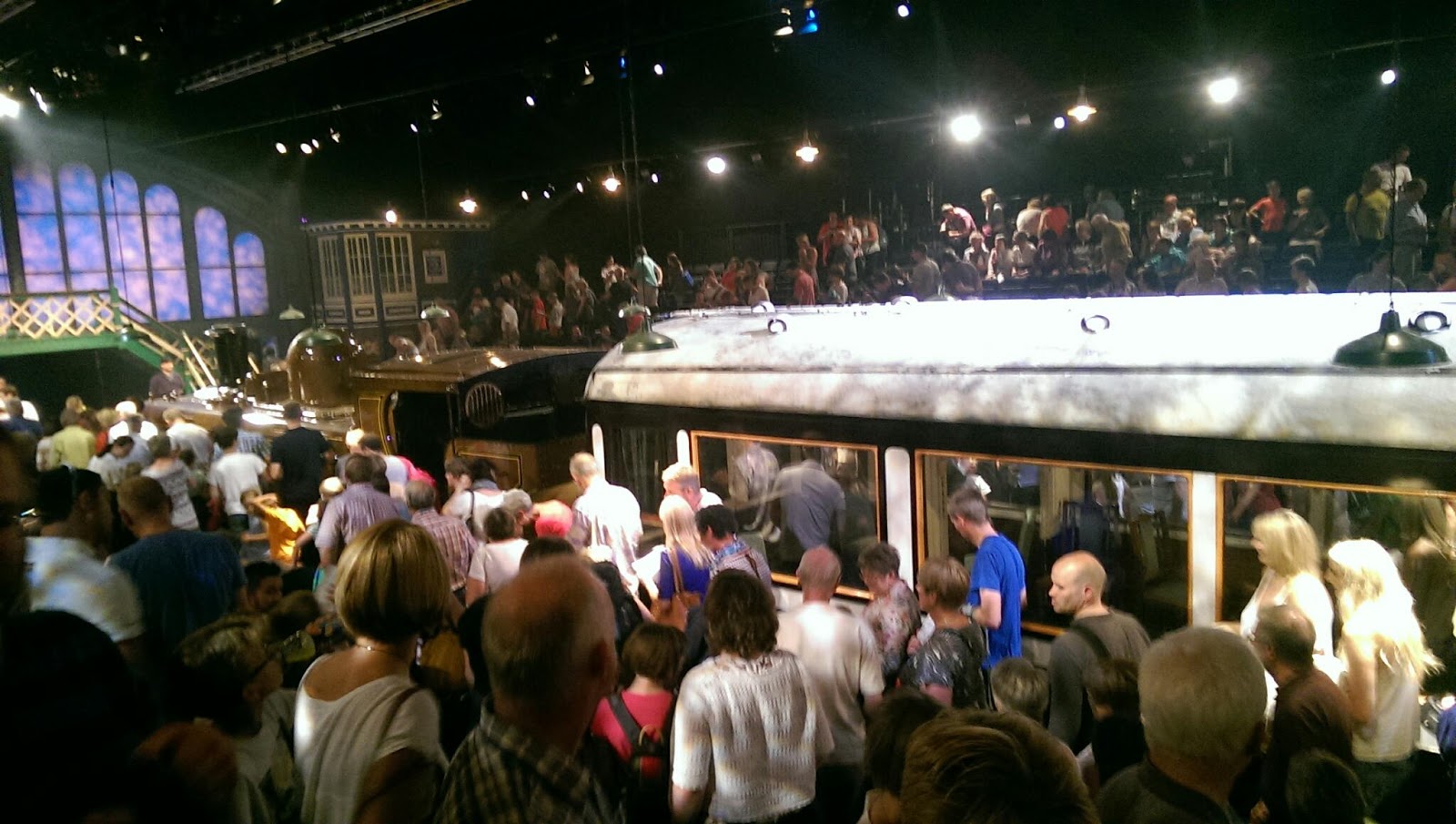
We've celebrated Penny's birthday in various ways over the weekend. On Saturday a day trip to York  observing the elegance of racegoers and sharing the refinement of afternoon tea at Bettys...

The centrepiece was a wonderful performance of The Railway Children the Rail Museum's Signal box theatre. Happy reminders of reading and watching the film as and with children.

Through today's eyes we saw a story which praised kindness and perseverance in the face of destitution and despair. We noted the affirmative presence of an asylum seeker, the emancipation of women and the injustice that can be meted put by the elite to those who are relatively powerless..

Having said that a great production, very entertaining and moving, especially when the final family reunion scene was accompanied by a real steam engine!

The day itself included morning service at packed Ecclesall parish church with blessings and baptisms as well as copious  birthday greetings. A sunny Barbeque with some of the family turned into a wet carpet picnic with Hannah, Tom, Bethany and of course Maisy dog,  but nevertheless a great day enjoyed by all.

Happy birthday to a very special person x

Thursday, 20 August 2015

Festivals ahead

Well the original plan was to attend three festivals. Now it looks like there might be five and a half. Snape proms were the half. Fusion in Birmingham takes place over the bank holiday  weekend and my thinking is that I'll leave Greenbelt for the Saturday to go across to Birmingham for part of the day. And now I've just booked to go to Festival no6 in Portmerion the following weekend. As someone very wise and very close to me said 'it's a once in a lifetime opportunity' and I think she might be right!